
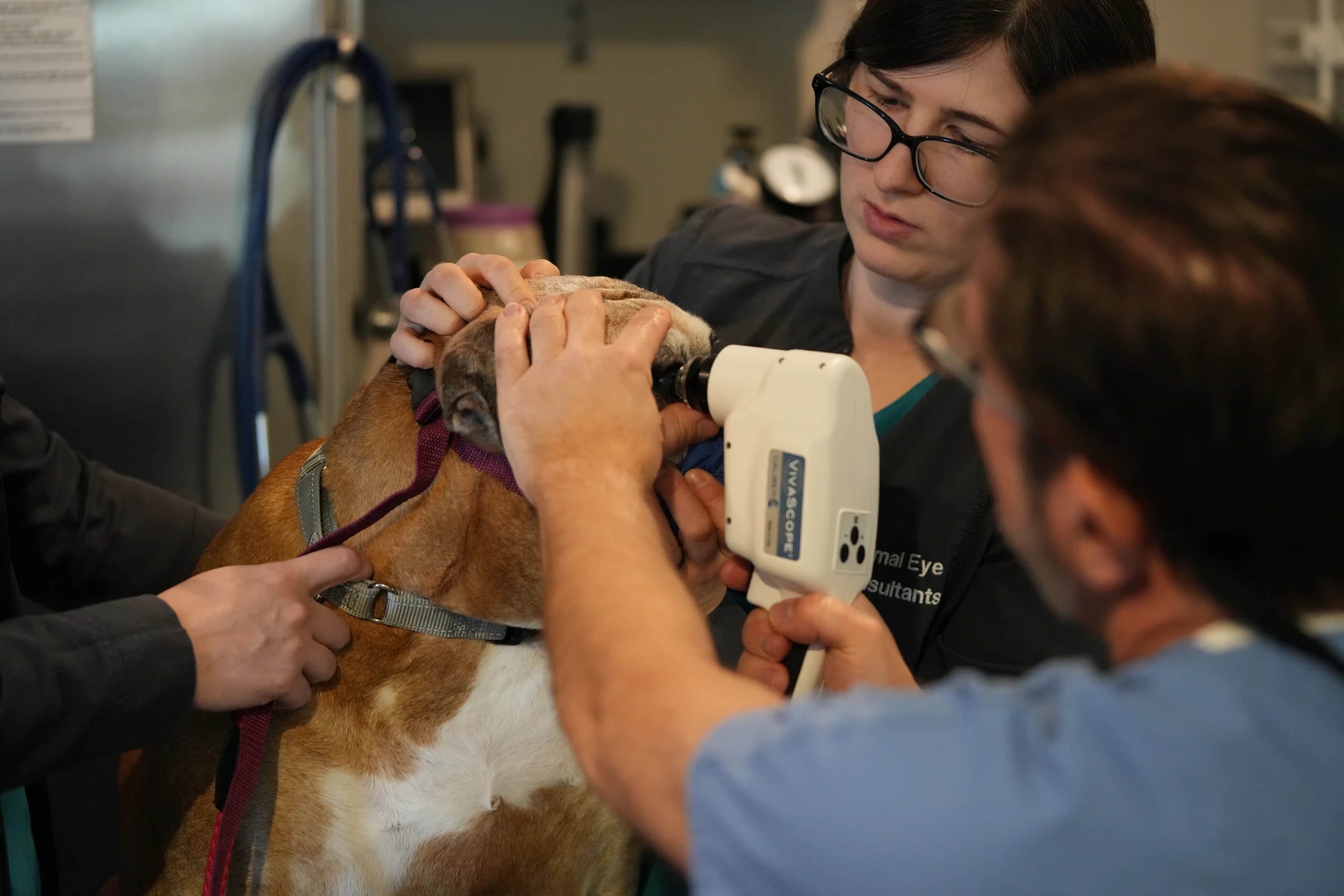
Research & Clinical Trials
About the Principal Investigator
Siniša D. Grozdanić, DVM, PhD, Dipl. ACVO, is a veterinary ophthalmologist, neuroscientist, surgeon, and translational researcher whose work focuses on preventing and treating blindness in animals. He is the founder of Animal Eye Consultants of Iowa and is affiliated with the Oculus veterinary ophthalmology program in Belgrade, Serbia. His research spans sudden acquired retinal degeneration syndrome (SARDS), autoimmune retinopathy, glaucoma, retinal and optic-nerve neuroprotection, neurotrophic growth factors, advanced ocular diagnostics, antimicrobial resistance, orbital and vitreoretinal surgery, and artificial intelligence.
Dr. Siniša D. Grozdanić is a veterinary ophthalmologist, neuroscientist, surgeon, and translational vision researcher. He received his veterinary degree from the University of Belgrade, completed doctoral training in neuroscience, and completed a residency in veterinary ophthalmology at Iowa State University. He later served as an assistant professor and staff ophthalmologist in the Department of Veterinary Clinical Sciences at Iowa State University and became a Diplomate of the American College of Veterinary Ophthalmologists.
He is the founder and veterinary ophthalmologist at Animal Eye Consultants of Iowa in Hiawatha, Iowa, and is also affiliated with the Oculus specialty veterinary ophthalmology program in Belgrade, Serbia. His clinical work includes advanced management of corneal disease, cataract, glaucoma, retinal detachment, orbital disease, and complex ocular surgery in dogs, cats, and horses.
Dr. Grozdanić’s scientific program connects naturally occurring animal eye diseases with broader questions in neuroscience, immunology, molecular pathology, regenerative medicine, microbiology, imaging, and computational medicine. A central theme is the identification of retinal and optic-nerve function that remains viable after severe injury and may therefore be protected or restored through timely treatment.
His work on SARDS and antibody-mediated retinal disease developed from an early framework for canine autoimmune and paraneoplastic retinopathies into detailed clinical, histologic, molecular, and transcriptomic investigations. These studies have examined antiretinal immune responses, complement activation, retinal inflammation, subtle structural changes, cancer-associated retinopathy, and disease-specific molecular pathways.
In glaucoma and acute ocular ischemia, Dr. Grozdanić’s studies demonstrated that severe elevation of intraocular pressure can cause profound early loss of retinal and optic-nerve function, followed by partial recovery. This work provided experimental support for urgent treatment of acute glaucomatous crises and helped define the difference between functional recovery and persistent structural injury.
His neuroprotection research investigated endogenous and therapeutic neurotrophic signaling, including CNTF, BDNF, and GDNF. Sustained delivery systems and BDNF-secreting mesenchymal stem cells were evaluated as methods for preserving retinal ganglion cells and optic-nerve function in ischemic and hypertensive eyes.
Dr. Grozdanić has also contributed to the development of objective visual diagnostics, including chromatic pupillometry, pattern electroretinography, optical coherence tomography, and Raman spectroscopy. These tools are designed to localize dysfunction within the visual pathway and identify residual function that may not be apparent during a routine examination.
His ocular microbiology work addresses bacterial keratitis, antimicrobial susceptibility, multidrug resistance, and evidence-based empirical treatment. His surgical research includes endoscopic orbital approaches, intraoperative CT and image-guided removal of orbital foreign bodies, and vitreoretinal reattachment surgery. More recent collaborations apply neural networks to segmentation and recognition of canine ocular abnormalities.
Across these areas, Dr. Grozdanić’s goal is to move veterinary ophthalmology from the recognition of established blindness toward earlier detection, mechanism-based treatment, neuroprotection, antimicrobial stewardship, minimally invasive surgery, and restoration of vision.
Research Areas
Eight connected lines of investigation, each linking naturally occurring animal eye disease to a mechanism that can be measured, protected, or treated.
SARDS, Autoimmune Retinopathy, and Cancer-Associated Retinopathy
SARDS is a major focus of Dr. Grozdanić’s clinical and scientific work. His research has examined the possibility that sudden retinal blindness may involve antibody-mediated injury, complement activation, retinal inflammation, vascular dysfunction, and metabolic or systemic factors. The program progressed from a foundational review of antibody-mediated canine retinopathies to OCT, histology, immunohistochemistry, molecular analysis, clinical characterization of cancer-associated retinopathy, and comparative retinal transcriptomics. Together, these studies provide a linked framework for understanding SARDS and related immune-mediated retinal disorders while recognizing that the syndrome may be biologically heterogeneous.
Glaucoma, Acute Intraocular-Pressure Elevation, and Optic-Nerve Injury
A foundational part of Dr. Grozdanić’s research examines how acute and chronic pressure elevation affects photoreceptors, inner-retinal neurons, retinal ganglion cells, optic-nerve axons, and clinically measurable vision. Rat and canine studies showed profound early loss of retinal and optic-nerve function after severe pressure elevation, followed by partial recovery over days or weeks. Canine studies also demonstrated that apparent visual recovery can coexist with retinal thinning and persistent structural injury. Additional work characterized hereditary primary angle-closure glaucoma, retinal neuroinflammation, complement deposition, and future neuroprotective approaches.
Neurotrophic Growth Factors, Neuroprotection, and Regenerative Therapy
Dr. Grozdanić’s neuroprotection work investigated whether surviving retinal and optic-nerve pathways can be supported after ischemic or glaucomatous injury. Studies identified a transient endogenous CNTF response after acute ocular ischemia and evaluated sustained delivery of BDNF, GDNF, and CNTF using biodegradable microspheres. BDNF and GDNF produced the strongest functional preservation of the afferent visual pathway. The program later advanced to mesenchymal stem cells engineered to secrete BDNF, demonstrating preservation of retinal ganglion cells, optic-nerve structure, and visual function in chronically hypertensive eyes.
Chromatic Pupillometry, Electrophysiology, OCT, and Raman Spectroscopy
Dr. Grozdanić has developed and evaluated objective diagnostic methods that distinguish outer-retinal dysfunction from inner-retinal, retinal-ganglion-cell, and optic-nerve disease. Chromatic pupillary-light-reflex testing uses different wavelengths to assess rod-cone and melanopsin-associated pathways and can assist in the evaluation of SARDS, retinal detachment, optic neuropathy, and cataract-associated visual impairment. Related work has integrated full-field and pattern electroretinography, optical coherence tomography, retinal imaging, histology, and Raman spectroscopy to detect and classify functional and biochemical changes before advanced structural loss becomes obvious.
Ocular Microbiology and Antimicrobial Resistance
Dr. Grozdanić’s ocular-surface research includes bacterial keratitis, microbiologic identification, antimicrobial susceptibility, multidrug resistance, and evidence-based empirical treatment. A large study of canine stromal corneal ulcers identified common pathogens and resistance patterns and evaluated antibiotic combinations that provide broad coverage while culture results are pending. A 2026 non-peer-reviewed preprint extended this work to chronic non-healing ulcers and reported substantial bacterial recovery and increasing antimicrobial resistance, supporting the need for culture-guided therapy and antimicrobial stewardship.
Orbital Imaging, Endoscopy, and Minimally Invasive Surgery
Dr. Grozdanić’s orbital research integrates endoscopy, computed tomography, ultrasonography, surgical navigation, biopsy, and minimally invasive removal of orbital lesions and foreign bodies. Cadaveric and clinical studies demonstrated that endoscopic approaches can provide targeted access to orbital compartments while limiting surgical morbidity. Intraoperative CT and stereotactic navigation were evaluated for real-time localization and removal of orbital foreign bodies. His orbital work also includes the characterization and successful medical management of an unusual canine orbital osteoma.
Retinal Detachment and Vitreoretinal Surgery
Dr. Grozdanić’s clinical research includes retinal detachment and vitreoretinal procedures intended to restore vision in complex veterinary patients. A 2026 feline study evaluated giant retinal tears in cats with retinal detachment, identified associated risk factors, and described retinal reattachment using silicone-oil tamponade. The work supports vitreoretinal surgery as a potential vision-restoring option in carefully selected patients while also documenting postoperative complications that require long-term monitoring.
Key papers:
Feline giant retinal tearsArtificial Intelligence and Canine Ophthalmic Image Recognition
Dr. Grozdanić has collaborated with computer scientists on neural-network systems for segmentation and recognition of canine ocular abnormalities. The work uses specialist-reviewed clinical images, synthetic-image augmentation, U-Net architectures, and quantitative segmentation metrics. A 2024 study demonstrated that automated models can localize several clinically important ocular abnormalities, providing a foundation for future screening, teleophthalmology, image standardization, and transparent clinical decision support.
Key papers:
AI image-segmentation studyResearch Mission
The unifying goal of Dr. Grozdanić’s clinical and scientific work is to identify visual function that remains viable, determine the mechanisms placing it at risk, and develop practical methods to preserve or restore it. This approach connects laboratory neuroscience with naturally occurring veterinary disease and combines pressure control, immunomodulation, neuroprotection, antimicrobial stewardship, advanced diagnostics, image-guided surgery, and computational medicine.
The central question across this research program is not simply whether an eye is damaged, but which visual pathways remain functional and can still be protected or restored.
Clinical Trials
Active research studies at Animal Eye Consultants of Iowa.
Conference Presentations
Presentations from Dr. Grozdanić and his team at the American College of Veterinary Ophthalmology (ACVO) Annual Conference on the diagnosis and treatment of autoimmune retinal disease.
Intermediate SARDS — ACVO 2016
Advanced SARDS — ACVO 2022
Research Publications
Selected peer-reviewed publications from Dr. Grozdanić and his collaborators, most recent first.
Incidence of and treatment strategies for giant retinal tears in cats with retinal detachment
Grozdanić SD, Luzhetskii S, Lazić T. Canadian Veterinary Journal. 2026;67(6):670-678.
Temporal increase in antibiotic resistance in chronically treated non-healing ulcers (Preprint)
Grozdanić S, Joksimović M, Childs J, Racić D, Lazić T, Ford B. Preprints. 2026. doi:10.20944/preprints202606.1727.v1.
Retinal transcriptomic signatures in SARDS and cancer-associated retinopathy
Grozdanić S, Poleksić A, Racić D, Bock D, Lazić T, Kuehn M. Animals. 2026;16(7):1051. doi:10.3390/ani16071051.
Preoperative and intraoperative CT imaging for orbital foreign bodies identification and surgical planning in veterinary medicine
Grozdanić SD, Murtha H, Lazić T, Đukić S, Luzetskii S, Ursu DC, Sarment D. Acta Veterinaria-Beograd. 2024;74(3):367-397. doi:10.2478/acve-2024-0026.
Diagnosis of ophthalmologic diseases in canines based on images using neural networks for image segmentation
Burić M, Grozdanić S, Ivašić-Kos M. Heliyon. 2024;10(19):e38287. doi:10.1016/j.heliyon.2024.e38287.
Antibiotic recommendations for treatment of canine stromal corneal ulcers
Joksimović M, et al. Veterinary Sciences. 2023;10(2):66. doi:10.3390/vetsci10020066.
Endoscopic diagnostic and surgical orbital approach in canines
Đurić ML, Krstić VP, Lazić TM, Grozdanić SD. Acta Veterinaria Hungarica. 2022;70(2):100-112. doi:10.1556/004.2022.00017.
Presumed cancer-associated retinopathy mimicking SARDS in canines
Grozdanić SD, Lazić T, Kecova H, Mohan K, Adamus G, Kuehn MH. Veterinary Ophthalmology. 2021;24(2):125-155. doi:10.1111/vop.12853.
The future of canine glaucoma therapy
Komáromy AM, Bras D, Esson DW, et al. Veterinary Ophthalmology. 2019;22(5):726-740. doi:10.1111/vop.12678.
Optical coherence tomography and molecular analysis of SARDS eyes suggests the immune-mediated nature of retinal damage
Grozdanić SD, Lazić T, Kecova H, Mohan K, Kuehn MH. Veterinary Ophthalmology. 2019;22(3):305-327. doi:10.1111/vop.12597.
Spectral domain optical coherence tomography (SD-OCT) assessment of the healthy female canine retina and optic nerve
Hernandez-Merino E, Kecova H, Jacobson SJ, Hamouche KN, Nzokwe RN, Grozdanić SD. Veterinary Ophthalmology. 2011;14(6):400-405. doi:10.1111/j.1463-5224.2011.00887.x.
Characterization of structure and function of the mouse retina using pattern electroretinography, pupil light reflex, and optical coherence tomography
Mohan K, Harper MM, Kecova H, Ye EA, Lazić T, Sakaguchi DS, Kardon RH, Grozdanić SD. Veterinary Ophthalmology. 2012;15(Suppl 2):94-104. doi:10.1111/j.1463-5224.2012.01034.x.
Rapid diagnosis of retina and optic nerve abnormalities in canine patients with and without cataracts using chromatic pupil light reflex testing
Grozdanić SD, Kecova H, Lazić T. Veterinary Ophthalmology. 2013;16(5):329-340. doi:10.1111/vop.12003.
Detection and characterization of glaucoma-like canine retinal tissues using Raman spectroscopy
Wang Q, Grozdanić SD, Harper MM, et al. Journal of Biomedical Optics. 2013;18(6):067008. doi:10.1117/1.JBO.18.6.067008.
Successful medical treatment of an orbital osteoma in a dog
Grozdanić S, Riedesel EA, Ackermann MR. Veterinary Ophthalmology. 2013;16(2):135-139. doi:10.1111/j.1463-5224.2012.01029.x.
Transplantation of BDNF-secreting mesenchymal stem cells provides neuroprotection in chronically hypertensive rat eyes
Harper MM, Grozdanić SD, Blits B, et al. Investigative Ophthalmology & Visual Science. 2011;52(7):4506-4515. doi:10.1167/iovs.11-7346.
Neuroinflammation in advanced canine glaucoma
Jiang B, Harper MM, Kecova H, Adamus G, Kardon RH, Grozdanić SD, Kuehn MH. Molecular Vision. 2010;16:2092-2108.
Exogenous modulation of intrinsic optic nerve neuroprotective activity
Grozdanić SD, Lazić T, Kuehn MH, Harper MM, Kardon RH, Kwon YH, Lavik EB, Sakaguchi DS. Graefe’s Archive for Clinical and Experimental Ophthalmology. 2010;248(8):1105-1116. doi:10.1007/s00417-010-1336-7.
Functional and structural changes in a canine model of hereditary primary angle-closure glaucoma
Grozdanić SD, Kecova H, Harper MM, Nilaweera W, Kuehn MH, Kardon RH. Investigative Ophthalmology & Visual Science. 2010;51(1):255-263. doi:10.1167/iovs.09-4081.
Antibody-mediated retinopathies in canine patients: mechanism, diagnosis, and treatment modalities
Grozdanić SD, Harper MM, Kecova H. Veterinary Clinics of North America: Small Animal Practice. 2008;38(2):361-387. doi:10.1016/j.cvsm.2007.12.003.
Recovery of canine retina and optic nerve function after acute elevation of intraocular pressure: implications for canine glaucoma treatment
Grozdanić SD, Matić M, Betts DM, Sakaguchi DS, Kardon RH. Veterinary Ophthalmology. 2007;10(Suppl 1):101-107. doi:10.1111/j.1463-5224.2007.00584.x.
Evaluation of retinal status using chromatic pupil light reflex activity in healthy and diseased canine eyes
Grozdanić SD, Matić M, Sakaguchi DS, Kardon RH. Investigative Ophthalmology & Visual Science. 2007;48(11):5178-5183. doi:10.1167/iovs.07-0249.
Retinal synthesis and deposition of complement components induced by ocular hypertension
Kuehn MH, Kim CY, Ostojić J, et al. Experimental Eye Research. 2006;83(3):620-628. doi:10.1016/j.exer.2006.03.002.
Functional characterization of retina and optic nerve after acute ocular ischemia in rats
Grozdanić SD, Sakaguchi DS, Kwon YH, Kardon RH, Sonea IM. Investigative Ophthalmology & Visual Science. 2003;44(6):2597-2605. doi:10.1167/iovs.02-0600.
Interested in our research?
For more information about our studies and how to participate, please get in touch with Animal Eye Consultants of Iowa.