
Spontaneous Chronic Corneal Epithelial Defects (Indolent Ulcers)
Spontaneous chronic corneal epithelial defects, or indolent ulcers, are chronic erosions of the corneal epithelium that fail to heal through the normal physiologic wound-healing process and, if untreated, can persist for months. They are relatively common in middle-aged dogs. Because they are most frequently observed in Boxers, the condition is also known as a “Boxer ulcer.” In addition to Boxers, indolent ulcers are diagnosed more often in Boston Terriers, French Bulldogs, and Labrador Retrievers.
Several morphologic and functional abnormalities of the corneal epithelium have been identified in affected dogs. Microtrauma and poorly controlled allergies are considered possible contributing factors in the source. Corneal epithelium adjacent to the defect shows abnormal maturation and loose attachment to the corneal stroma. Clinically, the condition appears as a superficial corneal ulcer surrounded by a margin of loosely attached epithelium, producing a characteristic appearance after fluorescein staining. Vascularization is usually present. The severity of pain, manifested by blepharospasm, varies among patients.
Treatment
Corneal debridement is required to remove all epithelium that can be readily separated because of its loose attachment to the stroma. Diamond-burr debridement may be performed. Linear or punctate keratotomy can then be used. In some cases, particularly when the ulcer has been present for months, superficial keratectomy is indicated. The lesion may subsequently be protected with a conjunctival flap or a soft contact lens. Topical antibiotic therapy, systemic anti-inflammatory treatment, and an Elizabethan collar are required.
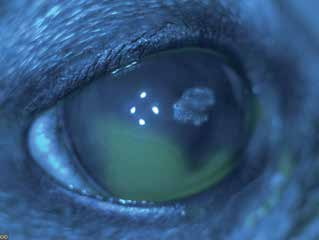
Spontaneous chronic epithelial defect of the canine cornea. A whitish area of corneal degeneration is located centrally, with an epithelial defect beneath it surrounded by edematous cornea.
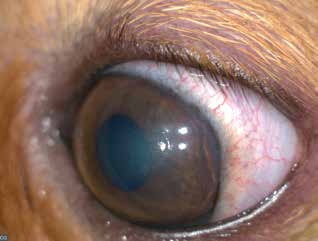
Spontaneous chronic epithelial defect of the canine cornea. The same dog after fluorescein staining, clearly demonstrating the defect.
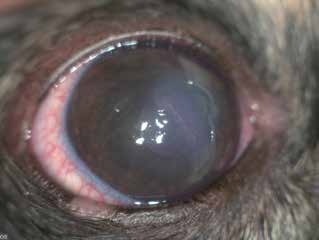
Spontaneous chronic epithelial defect of the canine cornea. A smaller defect that is readily visible.
Related in-depth guide
Corneal Disease
Our full guide, including treatment and surgical options
Adapted from the Atlas of Ocular Diseases in Dogs and Cats by Dr. Siniša D. Grozdanić and colleagues. © Animal Eye Consultants of Iowa. The text and clinical images on this page are original content from the authors' own clinical practice and research, and may not be reproduced, distributed, or repurposed without permission.
Think your pet may have spontaneous chronic corneal epithelial defects (indolent ulcers)?
Early evaluation gives us the most treatment options and the best chance of preserving vision.