
Hypermature Cataract
A cataract is any opacity of the normally transparent lens caused by structural alteration. It may be unilateral or bilateral, symmetric or asymmetric, stationary or progressive, and may develop slowly or rapidly. Dogs may develop cataracts at any age.
The causes listed in the source include hereditary cataract, diabetes mellitus, intoxication, adverse drug effects, nutritional deficiency, traumatic lens injury, uveitis, and retinal disease. Lens-protein leakage can cause a pronounced inflammatory response. Cataract can also result in glaucoma, vitreous degeneration, retinal detachment, lens subluxation or luxation, and loss of vision and/or the eye.
A hypermature cataract is one in which the lens cortex begins to liquefy and undergo resorption. Lysed proteins and water leave the lens, which decreases in size and develops an irregular contour. With diffuse illumination, portions of the lens may have a sparkling crystalline appearance. Multifocal subcapsular white plaques may be visible and some portions of the lens may again permit tapetal reflection. As lysis progresses, the lens nucleus may sink ventrally, producing a Morgagnian cataract. Uveitis is usually pronounced. Vitreous degeneration is generally present and may lead to retinal detachment. Glaucoma is a common complication.
Treatment
Diagnosis is established by ophthalmic examination. Uveitis should be treated with anti-inflammatory therapy. Phacoemulsification is described as the surgical treatment for hypermature cataracts to preserve vision and the eye, although surgery carries a higher complication risk at this stage.
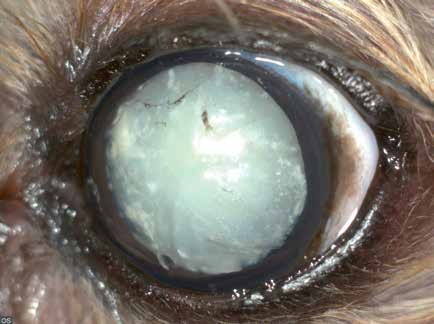
Hypermature cataract in a dog. Pigmentation of the anterior lens capsule and capsular fibrosis are visible.
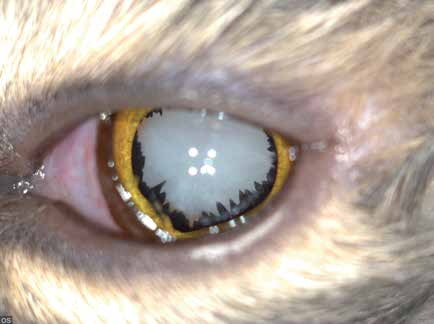
Hypermature cataract in a young cat with marked capsular fibrosis. Because the lens has undergone resorption, elongated ciliary processes are visible.
Related in-depth guide
Cataracts
Our full guide, including treatment and surgical options
Adapted from the Atlas of Ocular Diseases in Dogs and Cats by Dr. Siniša D. Grozdanić and colleagues. © Animal Eye Consultants of Iowa. The text and clinical images on this page are original content from the authors' own clinical practice and research, and may not be reproduced, distributed, or repurposed without permission.
Think your pet may have hypermature cataract?
Early evaluation gives us the most treatment options and the best chance of preserving vision.