
Herpesvirus Keratitis
Feline herpesvirus (FHV-1) is a common cause of ophthalmic disease, particularly in kittens but also in adult cats. Infection is a major problem in cat shelters and multi-cat households. The virus is transmitted by direct contact and most commonly by airborne droplets. Once infected, a cat becomes a latent carrier, and the virus may reactivate whenever immunity decreases.
Clinical signs include fever, apathy, coughing, and sneezing associated with respiratory inflammation, as well as conjunctivitis, symblepharon, and branching superficial corneal ulcers, or ulcerative keratitis. The patient keeps the eye closed and ocular discharge develops. Signs may affect one or both eyes. Kittens encountering herpesvirus for the first time have a more severe clinical presentation than adult cats. In adult cats, viral reactivation may produce predominantly ophthalmic signs. Herpesvirus infection may be complicated by secondary infection, most commonly by mycoplasmas and chlamydial organisms, and may occur together with other viruses such as calicivirus.
Treatment
The source identifies PCR testing of tissue culture material as the most useful diagnostic test. Spontaneous recovery is possible in adult cats. When clinical signs are pronounced, topical and systemic antiviral medications are used together with L-lysine as described in the source. Corneal ulcers are treated medically or surgically.
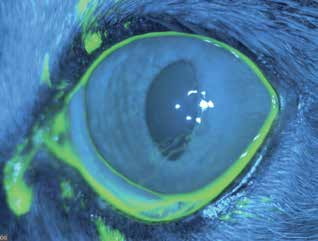
Herpesvirus keratitis. The characteristic branching erosion, a dendritic ulcer, becomes visible after fluorescein staining.
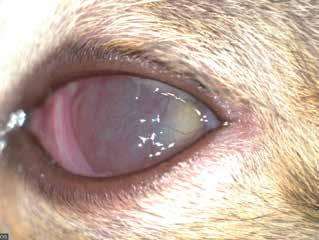
Herpesvirus keratitis. Chemosis, corneal edema, and vascularization are pronounced, with mucopurulent material beneath the margin of the upper eyelid.
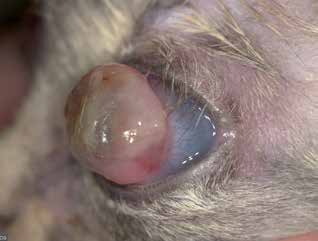
Herpesvirus keratitis in a one-month-old kitten. Acute herpesvirus infection and secondary bacterial contamination resulted in ulceration and corneal perforation with iris prolapse.
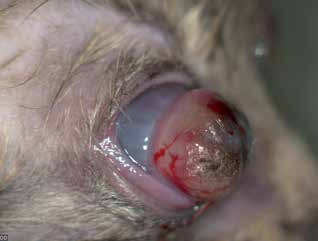
Herpesvirus keratitis with bacterial complications. The same kitten as in the previous figure, opposite eye.
Related in-depth guide
Corneal Disease
Our full guide, including treatment and surgical options
Adapted from the Atlas of Ocular Diseases in Dogs and Cats by Dr. Siniša D. Grozdanić and colleagues. © Animal Eye Consultants of Iowa. The text and clinical images on this page are original content from the authors' own clinical practice and research, and may not be reproduced, distributed, or repurposed without permission.
Think your pet may have herpesvirus keratitis?
Early evaluation gives us the most treatment options and the best chance of preserving vision.