
Diffuse Scleritis
Diffuse scleritis is an inflammatory condition of the sclera, often also involving the episclera, and is most commonly immune-mediated. Less commonly, it can be caused by Ehrlichia infection, toxoplasmosis, parasitic infestation such as Onchocerca spp., or ocular trauma including surgery, injury, or penetration by a foreign body.
Certain dogs are considered to have an inherited predisposition to immune-mediated bilateral scleritis, including Collies, American Cocker Spaniels, and Golden Retrievers. Scleritis may occasionally be the first sign of a systemic autoimmune disease. The most common visible changes are red infiltrates and engorged blood vessels adjacent to the limbus. Corneal edema and infiltrates, uveal changes, and fundic changes may also occur when the posterior sclera is involved. Scleritis is markedly painful.
A rare necrotizing form of scleritis can occur in dogs. It is associated with vasculitis and a severe clinical presentation. All ocular structures may become involved, resulting in keratitis, uveitis, glaucoma, retinal detachment, and cataract. The prognosis for both vision and the eye is poor. Cocker Spaniels and Boston Terriers are described as predisposed.
Treatment
Biopsy and histopathologic examination can determine the type of pathologic change. Topical and systemic nonsteroidal anti-inflammatory medications are used together with topical corticosteroids. Immune-mediated scleritis is controlled with corticosteroids and other immunosuppressive medications.
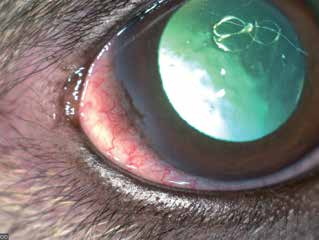
Scleritis in a dog. A rich network of scleral blood vessels is clearly visible at the limbus.
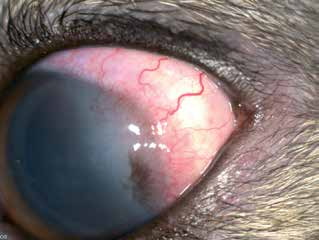
Scleritis in a dog. The clinical changes are more pronounced, the scleral blood vessels are more prominent, corneal edema is present, and temporal corneal pigmentation is visible.
Related in-depth guide
Corneal Disease
Our full guide, including treatment and surgical options
Adapted from the Atlas of Ocular Diseases in Dogs and Cats by Dr. Siniša D. Grozdanić and colleagues. © Animal Eye Consultants of Iowa. The text and clinical images on this page are original content from the authors' own clinical practice and research, and may not be reproduced, distributed, or repurposed without permission.
Think your pet may have diffuse scleritis?
Early evaluation gives us the most treatment options and the best chance of preserving vision.