
Variations in Eye Color
Dogs and cats have many normal variations in eye color, often characteristic of the breed. Iris heterochromia refers to different iris colors within one or both eyes. Most commonly, two different colors are present within a single iris, either as sharply demarcated regions or as islands of various shapes and sizes that differ from the background iris color. In some dog breeds, such as Siberian Huskies and Malamutes, one iris commonly differs in color from the other.
Iris heterochromia is not a pathologic condition, although it may occasionally occur as part of a rare genetic anomaly in dogs with harlequin coloration together with other ocular abnormalities, including in Collies, Australian Shepherds, Great Danes, and Dachshunds. The term subalbinism describes a light-colored eye, often in shades of blue, with an easily visible red reflection from a nonpigmented fundus.
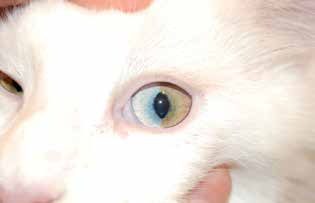
Iris heterochromia in a cat.
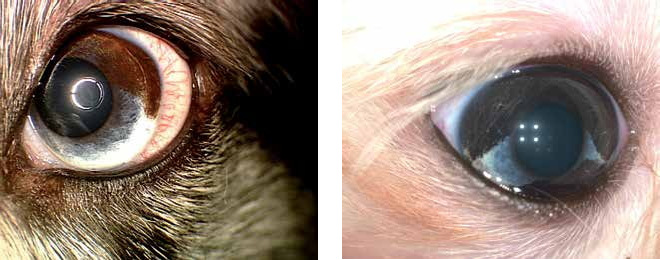
Iris heterochromia in a dog.
Adapted from the Atlas of Ocular Diseases in Dogs and Cats by Dr. Siniša D. Grozdanić and colleagues. © Animal Eye Consultants of Iowa. The text and clinical images on this page are original content from the authors' own clinical practice and research, and may not be reproduced, distributed, or repurposed without permission.
Think your pet may have variations in eye color?
Early evaluation gives us the most treatment options and the best chance of preserving vision.