
Uveal Cysts
Uveal cysts are of neuroectodermal origin and are common in dogs. They arise from the posterior pigmented epithelium of the iris or the inner epithelium of the ciliary body. They are observed more frequently in certain breeds, including Boston Terriers, Labrador Retrievers, and Golden Retrievers. Most are incidental findings and do not cause important ophthalmic problems.
Ciliary body cysts in Golden Retrievers and Great Danes are described as often being accompanied by intraocular inflammation and glaucoma when cyst contents are released into the intraocular space. Clinically, uveal cysts appear as solitary or multiple, darkly pigmented oval structures of variable size that may float freely or remain attached within the anterior or posterior chamber. Rarely, they are nonpigmented and translucent. Cysts may rupture, with their contents depositing in the filtration angle, on the lens, or on the corneal endothelium.
Treatment
Diagnosis is based on ophthalmic examination and, when necessary, ultrasonography. Uveal cysts are generally benign and require no treatment unless they are numerous or large enough to interfere with vision or obstruct the filtration angle and thereby cause secondary glaucoma. Treatment options include laser destruction, aspiration with a needle and syringe, or surgical extraction.
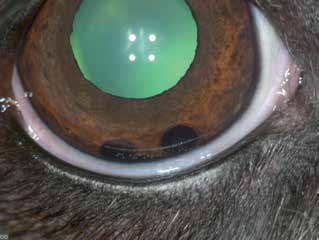
Multiple uveal cysts in the ventral portion of the anterior chamber of a dog.
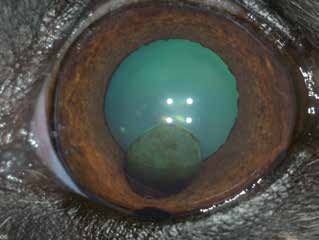
Large uveal cyst floating in the anterior chamber. The cyst is translucent and ocular structures can be seen through it.
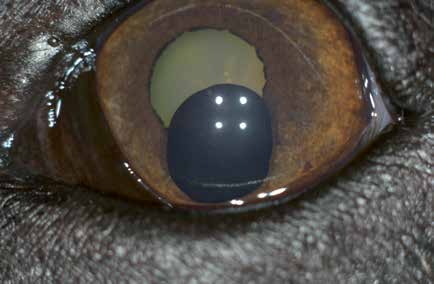
Large, dark, almost opaque cyst in the anterior chamber.
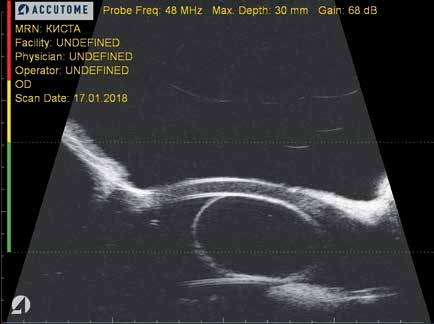
Ultrasound image of a uveal cyst. When a cyst is very dark and opaque, ultrasonography may be required to differentiate it from a tumor. The image demonstrates fluid contents and a thin cyst wall.
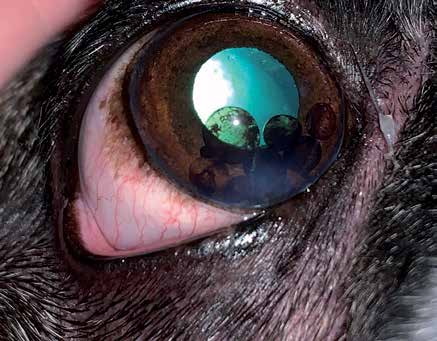
Numerous ciliary body cysts causing corneal endothelial damage in this dog. Surgical removal is recommended in such cases.
Adapted from the Atlas of Ocular Diseases in Dogs and Cats by Dr. Siniša D. Grozdanić and colleagues. © Animal Eye Consultants of Iowa. The text and clinical images on this page are original content from the authors' own clinical practice and research, and may not be reproduced, distributed, or repurposed without permission.
Think your pet may have uveal cysts?
Early evaluation gives us the most treatment options and the best chance of preserving vision.