
Taurine-Deficiency Retinopathy
Taurine is an essential amino acid, and cats have limited capacity to synthesize it. Taurine stores are present in the liver, heart, and retina, with particularly high concentrations in photoreceptors. Inadequate dietary taurine results in central retinal degeneration. This was observed in cats fed dog food.
Fundic changes are described as characteristic. Initially, granularity develops in the central fundus, followed by a rhomboid or ellipsoid hyperreflective lesion. A second hyperreflective lesion then develops and gradually merges with the first. The final stage is generalized retinal degeneration with attenuation or loss of retinal vasculature. The source notes that this disease has become uncommon because commercial diets are supplemented with taurine.
Treatment
If taurine deficiency is suspected, plasma taurine should be measured. Established blindness is irreversible, but taurine should be supplemented promptly because other organ systems are also affected by deficiency. Commercial cat food containing adequate taurine should be used.
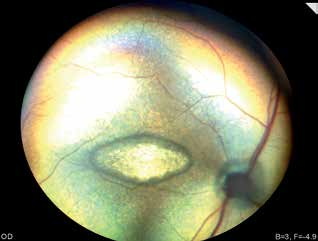
Characteristic feline fundic lesion secondary to taurine deficiency.
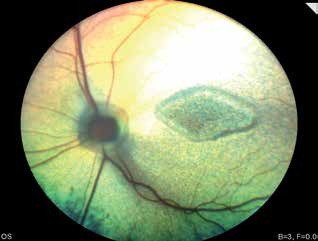
Feline fundic change caused by taurine deficiency.
Related in-depth guide
Retinal Disorders
Our full guide, including treatment and surgical options
Adapted from the Atlas of Ocular Diseases in Dogs and Cats by Dr. Siniša D. Grozdanić and colleagues. © Animal Eye Consultants of Iowa. The text and clinical images on this page are original content from the authors' own clinical practice and research, and may not be reproduced, distributed, or repurposed without permission.
Think your pet may have taurine-deficiency retinopathy?
Early evaluation gives us the most treatment options and the best chance of preserving vision.