
Retinal Pigment Epithelial Dystrophy (RPED)
Retinal pigment epithelial dystrophy is a group of inherited dystrophic diseases that primarily affect the retinal pigment epithelium and produce characteristic ophthalmoscopic changes. Irregular focal light-brown pigment accumulations appear in the central tapetal fundus. Over time, they enlarge to involve the entire tapetal and later nontapetal regions. Secondary retinal atrophy develops, with hyperreflective zones surrounding pigment lesions.
As disease progresses, owners may notice altered vision. A dog may retain peripheral vision and detect moving or distant objects but have difficulty seeing stationary objects close to the eye. Night blindness is initially present and later followed by daytime blindness; the source describes rods as affected before cones. Secondary cataract is common. Breeds listed include Briards, Labrador Retrievers, Golden Retrievers, Collies, Shetland Sheepdogs, Cocker Spaniels, and Welsh Corgis. Congenital blindness associated with RPED is described in American Briards in the source.
Treatment
Diagnosis is based on fundic examination and ERG. Genetic testing is available for some forms. No treatment is described. Affected animals should be excluded from breeding.
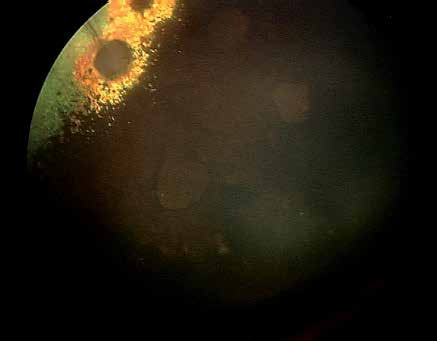
Retinal pigment epithelial dystrophy in a dog.
Related in-depth guide
Retinal Disorders
Our full guide, including treatment and surgical options
Adapted from the Atlas of Ocular Diseases in Dogs and Cats by Dr. Siniša D. Grozdanić and colleagues. © Animal Eye Consultants of Iowa. The text and clinical images on this page are original content from the authors' own clinical practice and research, and may not be reproduced, distributed, or repurposed without permission.
Think your pet may have retinal pigment epithelial dystrophy (rped)?
Early evaluation gives us the most treatment options and the best chance of preserving vision.