
Prolapse of the Third Eyelid Gland (Cherry Eye)
Prolapse of the third eyelid gland may be unilateral or bilateral and is common in young dogs from four weeks to two years of age. The exact cause is not known, but the condition is thought to result from weakness of the fibrous structures that hold the gland in position and from chronic inflammation, most commonly inflammation associated with allergies. Breeds predisposed to prolapse include the American Cocker Spaniel, English Bulldog, Boston Terrier, Lhasa Apso, Beagle, Shih Tzu, and Pekingese.
Prolapse of the gland occurs suddenly and appears as a red, rounded mass at the medial canthus. Conjunctivitis, ocular discharge, and ulcerative keratitis may accompany the condition. Tear production is usually reduced.
Treatment
According to the source, surgical excision of the prolapsed gland is absolutely contraindicated because many dogs develop dry eye disease within a shorter or longer interval after surgery, ranging from six months to six years. Surgical techniques that reposition and preserve the prolapsed gland are therefore recommended. Complications depend considerably on the surgical technique selected and most commonly include recurrence or development of a third eyelid cyst.
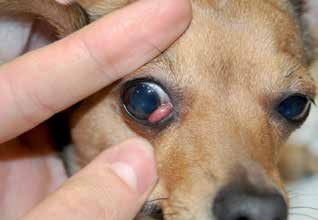
Prolapse of the third eyelid gland in the right eye of a dog.
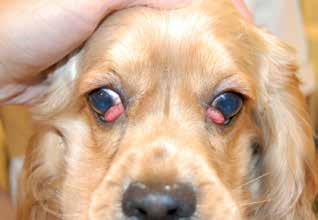
Bilateral prolapse of the third eyelid glands in a dog.
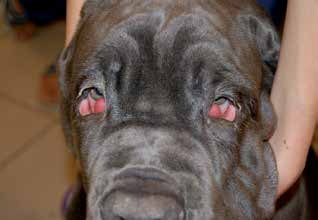
Prolapse of the third eyelid gland in both eyes of a dog. Bilateral ectropion and purulent discharge retained on the eyelids are also visible.
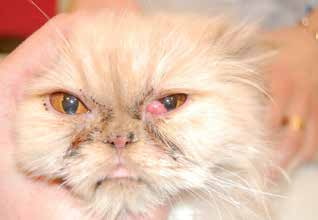
Prolapse of the third eyelid gland in the left eye of a brachycephalic cat, a Persian.
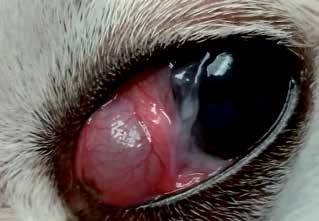
Third eyelid cyst that developed following previous surgery to reposition a prolapsed third eyelid gland.
Adapted from the Atlas of Ocular Diseases in Dogs and Cats by Dr. Siniša D. Grozdanić and colleagues. © Animal Eye Consultants of Iowa. The text and clinical images on this page are original content from the authors' own clinical practice and research, and may not be reproduced, distributed, or repurposed without permission.
Think your pet may have prolapse of the third eyelid gland (cherry eye)?
Early evaluation gives us the most treatment options and the best chance of preserving vision.