
Mucocutaneous Pyoderma
Mucocutaneous pyoderma is a bacterial infection of mucocutaneous junctions and most commonly affects the skin around the lips and eyes. Initial changes consist of symmetrical edema and erythema, most pronounced at the lip commissures. Crusts later form, with possible exudate beneath them, as well as erosions and ulceration. In chronic cases, depigmentation of the lips is common. These lesions are pruritic or painful, so the animal may resist examination and palpation. Similar changes may be present on the vulva, prepuce, or anus. Mucocutaneous pyoderma occurs more commonly in dogs, particularly German Shepherd Dogs.
Treatment
Diagnosis is based on the characteristic distribution of clinical signs and cytologic examination of a sample. Treatment includes topical antibacterial preparations; in more severe cases, systemic antibiotics are necessary for at least three weeks.
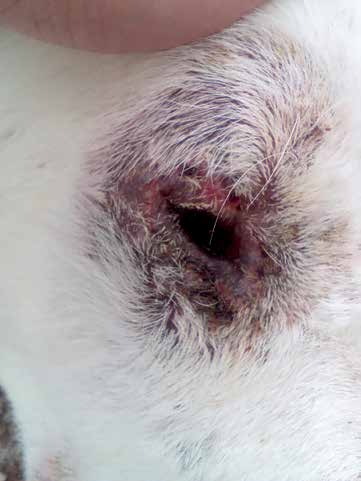
Mucocutaneous pyoderma. Alopecia, edema, and erythema are present.
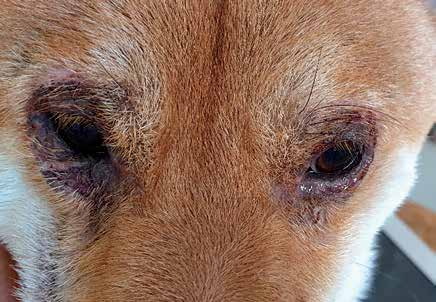
Mucocutaneous pyoderma. Alopecia, erythema, and crusts are visible.
Adapted from the Atlas of Ocular Diseases in Dogs and Cats by Dr. Siniša D. Grozdanić and colleagues. © Animal Eye Consultants of Iowa. The text and clinical images on this page are original content from the authors' own clinical practice and research, and may not be reproduced, distributed, or repurposed without permission.
Think your pet may have mucocutaneous pyoderma?
Early evaluation gives us the most treatment options and the best chance of preserving vision.