
Meibomian Gland Adenocarcinoma
Meibomian gland adenocarcinoma is a malignant, locally invasive tumor arising from the sebocytes of a Meibomian gland. It develops along the eyelid margin and is usually white to pale pink, less commonly darkly pigmented, and may be smooth or cauliflower-like. Morphologically, it cannot be distinguished from a benign adenoma. These tumors tend to progress and, in rare cases, may cause metastatic disease. Because of their local invasiveness, they can cause massive destruction of eyelid structures.
They frequently cause local irritation, and the dog may traumatize them by scratching, resulting in secondary bacterial infection. Depending on the location of the tumor, corneal and conjunctival irritation can result in keratitis, corneal ulceration, and conjunctivitis. These tumors may infiltrate the orbit, in which case removal of the eye and orbital tissues is indicated. Meibomian gland adenocarcinoma occurs in older dogs; it is rare in cats and, according to the source, is much more aggressive in that species.
Treatment
Surgical excision combined with cryotherapy produces excellent results in almost all patients according to the source. Diagnosis is established by histopathologic examination of the tumor after excision.
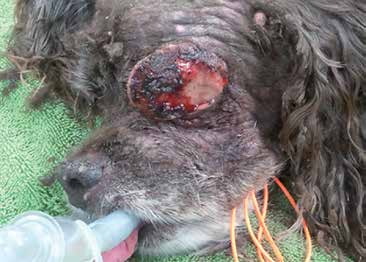
Meibomian gland adenocarcinoma of the upper eyelid in a 14-year-old Cocker Spaniel. In this case, the tumor had been neglected for years and completely destroyed the upper eyelid, infiltrated the orbital space, and metastasized to a regional lymph node. Surgical removal of the tumor, eye, orbital contents, and regional lymph node was performed. The patient died from renal insufficiency at 16 years of age without clinical signs of malignancy.
Adapted from the Atlas of Ocular Diseases in Dogs and Cats by Dr. Siniša D. Grozdanić and colleagues. © Animal Eye Consultants of Iowa. The text and clinical images on this page are original content from the authors' own clinical practice and research, and may not be reproduced, distributed, or repurposed without permission.
Think your pet may have meibomian gland adenocarcinoma?
Early evaluation gives us the most treatment options and the best chance of preserving vision.