
Macropalpebral Fissure
The upper and lower eyelids form an opening, or palpebral fissure. In every species and breed, the eyelids have an appropriate length that permits their normal supportive and protective functions for the globe. If the eyelids are excessively long, the upper and lower eyelids form an excessively large opening (macropalpebral fissure), allowing the globe to protrude excessively from the orbit. Such an eye is commonly described as "bulging."
Dogs with a macropalpebral fissure most often have incomplete eyelid closure (lagophthalmos), and some even sleep with their eyes open. Because the globe is excessively exposed to adverse environmental influences, these dogs may develop pigmentary keratitis (pigmented scar deposits on the corneal surface), keratoconjunctivitis, ulcerative keratitis, and dry eye disease. They are also predisposed to ocular proptosis, in which the globe protrudes beyond the eyelid margins. All of these conditions can compromise visual function. This anomaly is commonly seen in brachycephalic breeds including the Pekingese, Pug, Shih Tzu, Lhasa Apso, and Boston Terrier.
Treatment
Medical therapy is sufficient in most patients. The eye must be regularly protected with lubricants, the tear film must be stabilized, and complications such as keratitis or ulceration must be treated appropriately. In severe cases, surgical correction is performed by reducing the palpebral fissure through medial canthoplasty. In dogs predisposed to ocular proptosis, surgical reduction of the eyelid opening is mandatory.
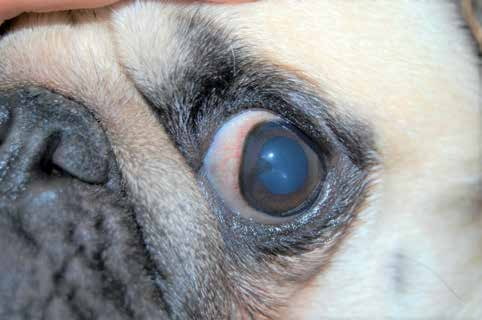
Pug with a macropalpebral fissure and lagophthalmos. Medial inversion of the eyelids is frequently present with this condition and causes chronic corneal irritation. Pigment deposits on the cornea are a breed-associated characteristic.
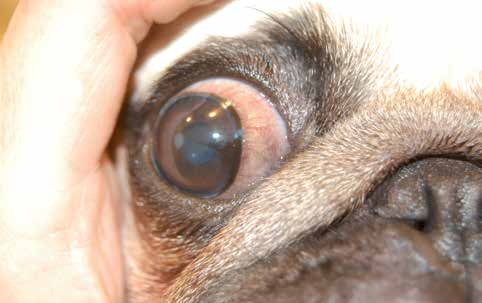
Pug with a macropalpebral fissure. This dog has more pronounced corneal pigmentation.
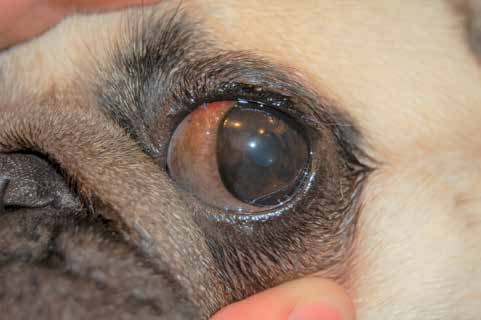
Pug with a macropalpebral fissure. This dog has dry eye disease.
Adapted from the Atlas of Ocular Diseases in Dogs and Cats by Dr. Siniša D. Grozdanić and colleagues. © Animal Eye Consultants of Iowa. The text and clinical images on this page are original content from the authors' own clinical practice and research, and may not be reproduced, distributed, or repurposed without permission.
Think your pet may have macropalpebral fissure?
Early evaluation gives us the most treatment options and the best chance of preserving vision.