
Histiocytoma
A histiocytoma is a benign tumor arising from cutaneous Langerhans cells. It appears as a solitary, well-demarcated mass on the eyelid skin. The lesion is hairless because the tumor causes alopecia and therefore appears pink. Central ulceration is common (so-called "central umbilication"). An important feature is that the tumor can spontaneously disappear or regress as a result of a T-lymphocyte immune response.
It generally does not cause a problem, but it may ulcerate, allowing secondary infection of the resulting wound, or may be prone to trauma and bleeding. Histiocytomas most commonly occur in young dogs, and the skin of the head, including the muzzle, ears, and eyelids, is a predilection site. They are common in Bulldogs, Staffordshire Terriers, Pit Bull Terriers, Scottish Terriers, Cocker Spaniels, Boxers, and Dachshunds. Histiocytoma has not been reported in cats according to the source.
Treatment
Some tumors are anatomically similar to histiocytoma but are malignant, such as mast cell tumors. Accurate diagnosis is therefore extremely important. Diagnosis is made by histopathologic analysis. Histiocytomas often do not need surgical removal because they may disappear spontaneously within approximately three months after they first appear. If they do not regress spontaneously, or if their location causes problems by irritating the cornea or predisposing to bleeding or infection, they may be surgically removed.
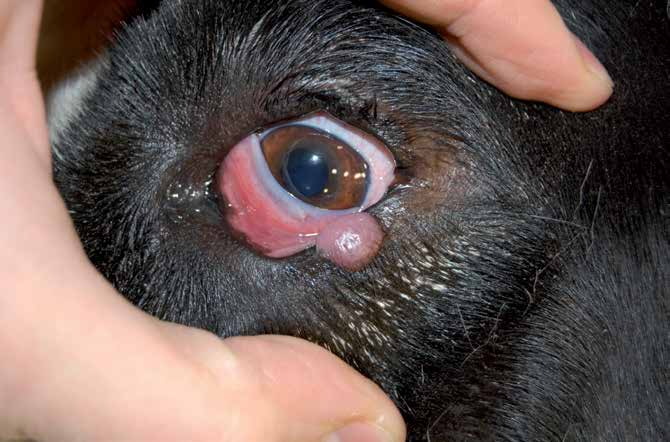
Histiocytoma of the lower eyelid in a young dog. The mass is smooth, well-defined, hairless, round, and pink.
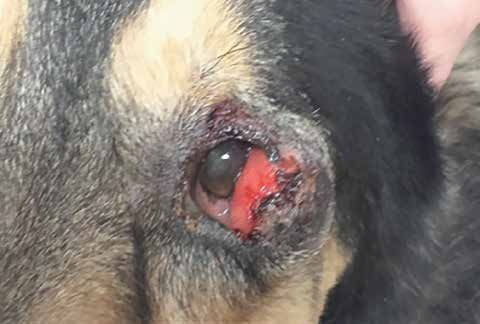
Large histiocytoma in an older dog. The histiocytoma ulcerated and caused marked eyelid damage and compression of the globe.
Adapted from the Atlas of Ocular Diseases in Dogs and Cats by Dr. Siniša D. Grozdanić and colleagues. © Animal Eye Consultants of Iowa. The text and clinical images on this page are original content from the authors' own clinical practice and research, and may not be reproduced, distributed, or repurposed without permission.
Think your pet may have histiocytoma?
Early evaluation gives us the most treatment options and the best chance of preserving vision.