
Familial Canine Dermatomyositis
Familial canine dermatomyositis is a hereditary, idiopathic inflammatory disease of the skin and muscles. It most commonly occurs in puppies between two and six months of age. Collies and Shetland Sheepdogs are predisposed. In most cases, skin lesions are localized to sites of mechanical trauma, primarily the face around the eyes, muzzle, and ears, as well as the carpal and tarsal joints, digits, and tip of the tail. Alopecia, erythema, scales, crusts, ulcerations, and scarring are present.
Myositis most commonly develops months after the appearance of skin lesions and varies in severity. Some dogs are asymptomatic, whereas others develop symmetrical atrophy of the masseter and/or temporal muscles. Severe cases may develop generalized symmetrical muscle atrophy.
Treatment
Diagnosis is established by excluding other diseases and by histopathologic analysis of skin and muscle samples. Skin trauma and exposure to sunlight should be prevented in affected dogs. Treatment consists of managing secondary infections and administering omega-3 and omega-6 fatty acids and vitamin E. In severe cases, pentoxifylline and corticosteroids at anti-inflammatory doses are recommended.
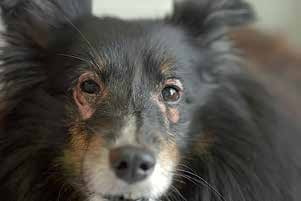
Familial canine dermatomyositis. Alopecia, erythema, and erosions. Photo: N. Lemo.
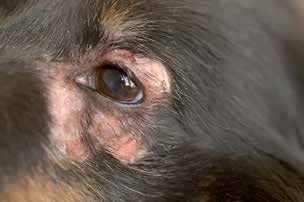
Familial canine dermatomyositis. Alopecia, erythema, and erosions. Photo: N. Lemo.
Adapted from the Atlas of Ocular Diseases in Dogs and Cats by Dr. Siniša D. Grozdanić and colleagues. © Animal Eye Consultants of Iowa. The text and clinical images on this page are original content from the authors' own clinical practice and research, and may not be reproduced, distributed, or repurposed without permission.
Think your pet may have familial canine dermatomyositis?
Early evaluation gives us the most treatment options and the best chance of preserving vision.