
Excessive Tear Overflow Syndrome (Epiphora)
Epiphora is excessive overflow of tears from the palpebral fissure. It most commonly occurs as a result of intense tearing (hypersecretion), meaning increased tear-film production secondary to inflammatory processes, particularly ocular allergy. Epiphora also occurs frequently with atresia of the lacrimal ducts, absent lacrimal puncta, micropuncta, or obstruction of the lacrimal drainage system. In all of these conditions, drainage of the tear film is impaired and tears overflow from the eye. A lower eyelid laceration may also create an anatomical defect that prevents retention of the tear film and causes excessive tear overflow.
In many dog breeds, particularly toy breeds, hairs from the medial canthus touch the cornea and act as a "wick" for tear drainage. In these breeds, the anatomy of the orbit and eyelids contributes to impaired tear drainage and epiphora, including a short muzzle, pronounced stop, large eyes, and a mildly prominent globe. Breeds predisposed to this problem include Shih Tzus and Lhasa Apsos (brachycephalic breeds), Miniature Poodles, Maltese, and Bichons. In cats, the condition most commonly occurs as a consequence of brachycephalic head conformation and specific eyelid conformation, especially in Persian cats.
Dogs with epiphora develop a brown, moist track from the medial canthus toward the muzzle. Persistent wetting of this region can result in dermatitis.
Treatment
Tear hypersecretion must first be excluded as the reason for the clinical presentation. The cause of epiphora is then investigated. The eye is examined under magnification with particular attention to the lacrimal punctum, any lacerations, and other anatomical defects. Nasolacrimal duct patency is evaluated using fluorescein testing, cannulation, and flushing.
If hairs are the cause of epiphora, they are removed by cryoepilation or the skin of that region is surgically corrected. If nasolacrimal obstruction is present, cannulation and flushing are performed, or the obstruction is removed using specialized instruments or surgery. An absent lacrimal punctum may require surgical reconstruction.
In some cases, idiopathic epiphora can be controlled medically with systemic and topical antiallergy medications, tetracyclines, or metronidazole, and it may be treated surgically by creating a fistula between the medioventral palpebral conjunctiva of the lower eyelid and the nasal cavity.
In toy breeds predisposed to epiphora, proper eye and periocular hair care is usually sufficient. In more severe cases, chronic wetting of the face can cause facial dermatitis.
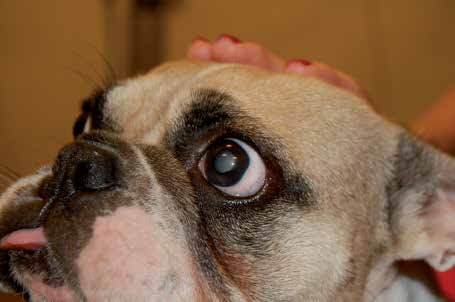
Epiphora. In this French Bulldog, a track of overflowing tears is visible. The condition is chronic, as indicated by discoloration of the hair that has remained in contact with tears for an extended period.
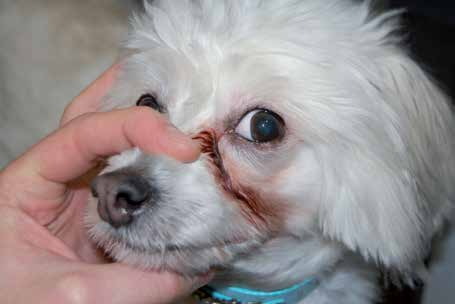
Epiphora in a dog. Note discoloration of the hair that remains in constant contact with tears.
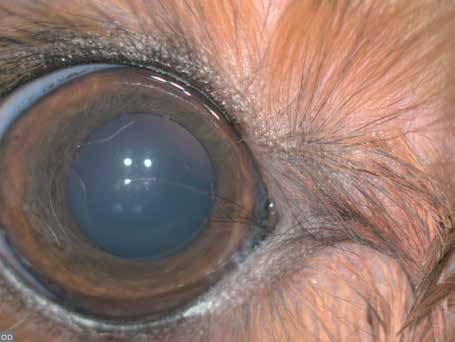
Epiphora caused by trichiasis.
Adapted from the Atlas of Ocular Diseases in Dogs and Cats by Dr. Siniša D. Grozdanić and colleagues. © Animal Eye Consultants of Iowa. The text and clinical images on this page are original content from the authors' own clinical practice and research, and may not be reproduced, distributed, or repurposed without permission.
Think your pet may have excessive tear overflow syndrome (epiphora)?
Early evaluation gives us the most treatment options and the best chance of preserving vision.