
Erythema Multiforme and Toxic Epidermal Necrolysis
The exact pathogenesis of these two diseases is unknown, but direct toxic effects or an immune response to certain chemicals, medications, infection, or neoplasia are suspected. The distinction between the two diseases is still not fully clear in either human or veterinary medicine. Lesions occur on the skin, at mucocutaneous junctions, and in the oral cavity and are generally diffuse and acute in onset.
Erythema multiforme is characterized by erythematous macules or slightly raised papules that expand peripherally and become pale centrally, producing a target- or ring-like appearance. In toxic epidermal necrolysis, erythema appears first, followed by vesicles, bullae, necrosis, and ulceration. Systemic abnormalities such as pyrexia, anorexia, lethargy, and depression are present. The skin is painful and Nikolsky's sign is positive.
Treatment
Diagnosis is made by excluding other diseases and by histopathologic examination of affected skin. Treatment consists of discontinuing all medications the patient has been receiving, replacing fluids and electrolytes, and treating lesions to prevent infection and sepsis. In severe cases, corticosteroids at immunosuppressive doses are required. Erythema multiforme may resolve spontaneously after three to four weeks, whereas toxic epidermal necrolysis requires treatment for several months and, despite therapy, is fatal in approximately 30% of cases according to the source.
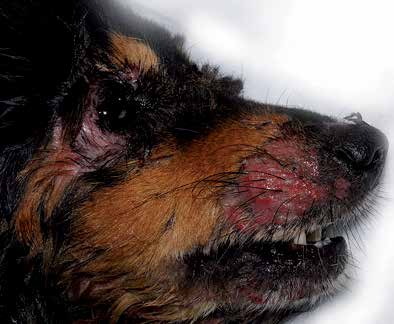
Toxic epidermal necrolysis.
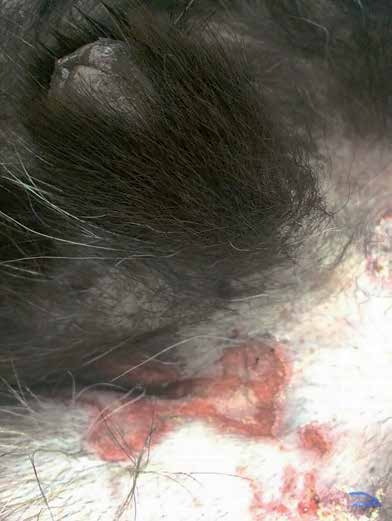
Erythema multiforme. Ring-shaped, sharply demarcated erythematous lesions with alopecia, erythema, erosions, and ulcerations. Photo: F. Banović.
Adapted from the Atlas of Ocular Diseases in Dogs and Cats by Dr. Siniša D. Grozdanić and colleagues. © Animal Eye Consultants of Iowa. The text and clinical images on this page are original content from the authors' own clinical practice and research, and may not be reproduced, distributed, or repurposed without permission.
Think your pet may have erythema multiforme and toxic epidermal necrolysis?
Early evaluation gives us the most treatment options and the best chance of preserving vision.