
Entropion
Entropion is inward rolling of the eyelid margin toward the globe. The lower eyelid is most commonly affected, but entropion may also involve the upper eyelid or both eyelids. The condition is generally bilateral. Causes of entropion are numerous, and it is most commonly associated with:
- Allergic diseases of the eyelids and follicular conjunctivitis.
- Dog breeds with excessively long eyelids and/or loose eyelids and excess skin, including the English Bulldog, Chow Chow, Shar-Pei, Saint Bernard, and Rottweiler.
- Dog breeds with short muzzles and a pronounced stop, including the Pekingese, Pug, English Bulldog, and Miniature Poodle.
- Conditions in which eyelid support, body fat, or muscle mass is lost, or the globe decreases in size, including older dogs and cats and animals with globe atrophy.
- Corneal ulcers or other painful ocular processes that cause chronic blepharospasm. In cats, this is the most common cause of entropion, although some feline breeds are also predisposed.
- Eyelid injury with scar formation, resulting in tissue contraction and inward rolling of the eyelid.
Clinical signs arise as a consequence of ocular irritation (trichiasis) and may include tearing, chronic conjunctivitis, blepharospasm, keratitis, corneal ulceration, and development of corneal scar tissue or pigmentation.
Treatment
Spastic entropion is managed by treating the primary cause of the entropion, namely the source of ocular irritation or pain. Allergies must be controlled. Entropion can be temporarily corrected using nonabsorbable sutures, an effective approach in young dogs or in cases of spastic entropion.
The most reliable method for permanent correction of entropion is surgery. Numerous surgical procedures have been described, and the ophthalmologist selects the appropriate procedure after considering the breed, age, location of the entropion, and underlying cause. In some cases, two or more surgical procedures must be combined during the same operation. If the primary problem that caused the entropion is not corrected, even the best surgical procedure may fail. For this reason, a detailed ophthalmic examination by a trained specialist is recommended, because in many cases adequate medical treatment can eliminate the need for a complex surgical procedure. Consequences of entropion, including keratitis and/or corneal ulceration, must also be treated.
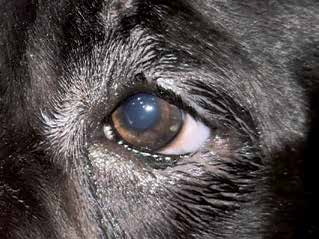
Cane Corso puppy with entropion of the lower eyelid. Hairs from the lateral portion of the lower eyelid irritate the cornea, resulting in excessive tearing and blepharospasm.
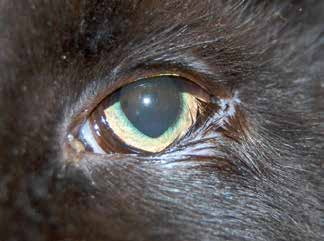
Entropion of the lower eyelid and trichiasis.
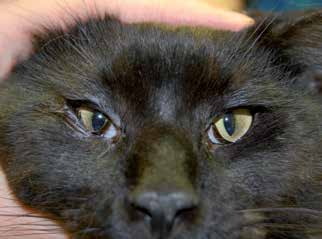
Maine Coon cat with entropion of the lower eyelid, a condition commonly seen in this breed.
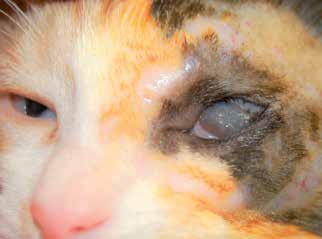
Secondary entropion in a cat.
Adapted from the Atlas of Ocular Diseases in Dogs and Cats by Dr. Siniša D. Grozdanić and colleagues. © Animal Eye Consultants of Iowa. The text and clinical images on this page are original content from the authors' own clinical practice and research, and may not be reproduced, distributed, or repurposed without permission.
Think your pet may have entropion?
Early evaluation gives us the most treatment options and the best chance of preserving vision.