
Distichiasis
Distichiasis is the presence of additional eyelashes emerging from the openings of the Meibomian glands along the eyelid margin. It is frequently a hereditary condition in dogs and may become a clinical problem during the first months of life. A breed predisposition is recognized, with Cocker Spaniels, Boxers, English Bulldogs, Yorkshire Terriers, and Shih Tzus among the breeds most commonly affected.
Distichiasis does not necessarily cause ocular problems, but it can do so depending on the length, number, and direction of the accessory eyelashes. If the eyelashes mechanically damage the ocular surface, blepharospasm (involuntary blinking and contraction of the eyelids), excessive tearing, and often keratitis and corneal ulceration may develop.
Treatment
If the hairs cause clinical problems, they must be removed and the hair follicles permanently destroyed. Manual epilation provides only temporary relief; therefore, the follicle must be permanently eliminated. This can be achieved by freezing the follicle (cryoepilation) or destroying it with electrolysis. Laser destruction of distichiae, thermocautery, or surgical resection of the hair follicles is not recommended in the source because of the possibility of damage to the eyelid margin and subsequent development of corneal ulceration.
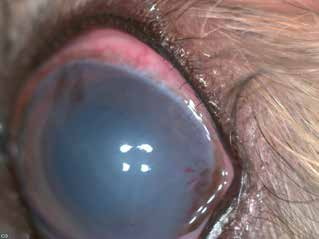
Distichiasis of the upper eyelid in a dog - black hairs arise from the medial portion of the upper eyelid. This dog has chronic corneal irritation, edema, vascularization, pigmentation, and a small ulcer in the lower portion of the cornea.
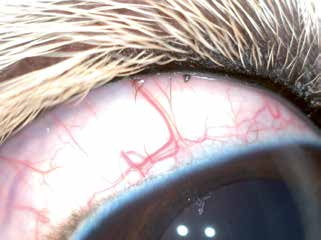
Distichiasis of the upper eyelid in a dog. The cilium is easily visible against the white sclera.
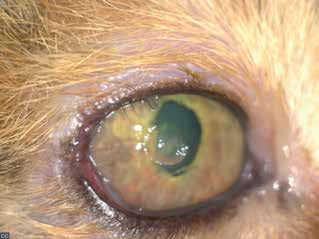
Distichiasis in the lateral portion of the upper eyelid in a cat, which is quite unusual. A corneal ulcer, excessive tearing, and periocular alopecia are present.
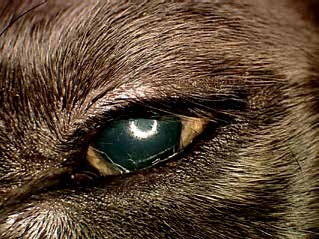
Distichiasis of the lower eyelid in a dog. Distichiasis of the upper eyelid can also be seen in this image, although it is more difficult to visualize against the black pupil. Blepharospasm and marked tearing are present.
Adapted from the Atlas of Ocular Diseases in Dogs and Cats by Dr. Siniša D. Grozdanić and colleagues. © Animal Eye Consultants of Iowa. The text and clinical images on this page are original content from the authors' own clinical practice and research, and may not be reproduced, distributed, or repurposed without permission.
Think your pet may have distichiasis?
Early evaluation gives us the most treatment options and the best chance of preserving vision.