
Demodex-Induced Dermatitis
Demodex canis and Demodex cati are skin parasites that inhabit the hair follicles and sebaceous glands of dogs and cats and form part of the normal cutaneous microflora. An increase in parasite numbers and development of clinical skin signs most commonly occur in animals with compromised immune status or concurrent disease. Breeds predisposed to demodicosis include Shar-Peis, Pugs, West Highland White Terriers, Great Danes, Bulldogs, Weimaraners, Airedale Terriers, sighthounds, and Doberman Pinschers.
Demodicosis has two clinical forms: localized and generalized. Localized demodicosis affects the head, most commonly the periocular region, lips, and muzzle. Affected areas show erythema, alopecia, scaling, and hyperpigmentation. Secondary bacterial skin infections are common. In generalized demodicosis, lesions are diffusely distributed, are almost always accompanied by deep bacterial skin infection, and may be associated with abnormalities of general health.
Treatment
Diagnosis is made by microscopic examination of skin scrapings and detection of increased numbers of adult or developmental forms of Demodex. Localized demodicosis resolves spontaneously, while the generalized form is most commonly treated with products containing isoxazolines. Secondary bacterial skin infection is treated with antibiotics selected according to antimicrobial susceptibility testing.
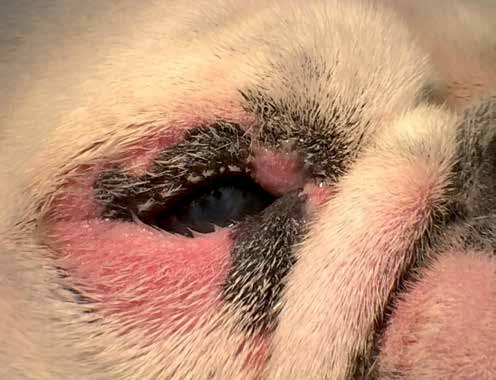
English Bulldog with Demodex-associated blepharitis. Periocular redness and thinning of the hair are present, together with ocular discharge.
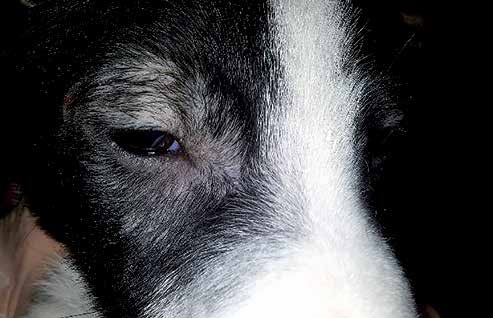
Localized demodicosis. Thinning of the hair in the periocular region.
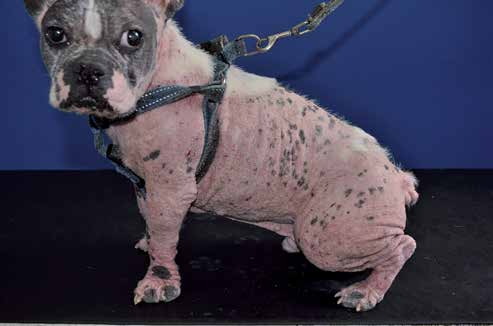
Generalized juvenile demodicosis. Diffuse alopecia, erythema, papules, pustules, and scales in a young dog.
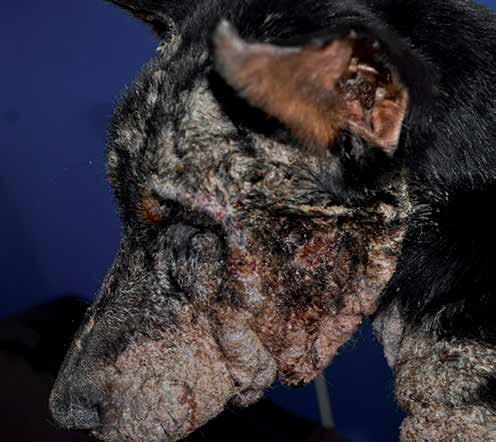
Generalized adult-onset demodicosis. Diffuse alopecia, hyperpigmentation, pustules, crusts, and cutaneous hemorrhage in an adult dog.
Adapted from the Atlas of Ocular Diseases in Dogs and Cats by Dr. Siniša D. Grozdanić and colleagues. © Animal Eye Consultants of Iowa. The text and clinical images on this page are original content from the authors' own clinical practice and research, and may not be reproduced, distributed, or repurposed without permission.
Think your pet may have demodex-induced dermatitis?
Early evaluation gives us the most treatment options and the best chance of preserving vision.