
Collie Eye Anomaly (CEA)
Collie Eye Anomaly is an autosomal recessive inherited ophthalmic syndrome involving abnormal intrauterine differentiation of posterior ocular structures. The source associates it with mutation of the NHEJ1 gene. Changes may involve the sclera, choroid, optic disc, and retina. A characteristic sign is choroidal hypoplasia lateral to the optic nerve head.
Affected dogs may show retinal detachment, intraocular hemorrhage, staphyloma, optic disc coloboma, abnormal retinal vascular appearance, retinal dysplasia with folds and rosettes, and microphthalmia. Changes are bilateral but not always symmetric. Some dogs remain asymptomatic with good vision and the lesions are discovered incidentally. Severe changes with retinal detachment or hyphema reduce vision or cause blindness. CEA occurs in Collies, Australian Shepherds, and Shetland Sheepdogs.
Treatment
Diagnosis is based on ophthalmic examination. Mild cases can be missed, particularly when older puppies are examined. Choroidal hypoplasia visible at five to seven weeks may become obscured later as retinal pigment develops. Genetic testing is described as the most reliable diagnostic method. There is no specific treatment, although individual complications such as hyphema or retinal detachment can be managed medically or surgically. Selective breeding is emphasized for prevention.
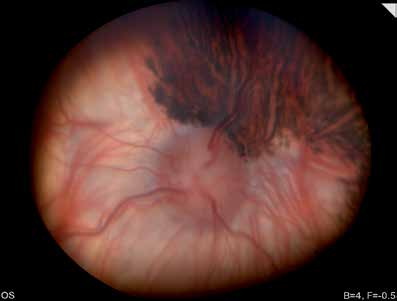
CEA in a Collie. Choroidal hypoplasia is visible.
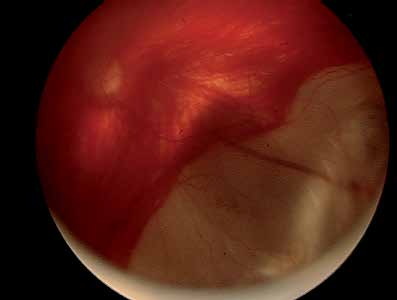
CEA in an Australian Shepherd with choroidal and scleral coloboma.
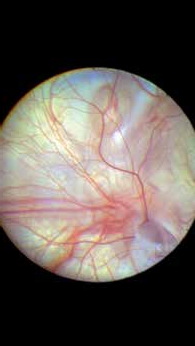
CEA in a dog. Multiple congenital abnormalities are visible, including optic nerve coloboma and choroidal hypoplasia with a colobomatous scleral defect.
Related in-depth guide
Retinal Disorders
Our full guide, including treatment and surgical options
Adapted from the Atlas of Ocular Diseases in Dogs and Cats by Dr. Siniša D. Grozdanić and colleagues. © Animal Eye Consultants of Iowa. The text and clinical images on this page are original content from the authors' own clinical practice and research, and may not be reproduced, distributed, or repurposed without permission.
Think your pet may have collie eye anomaly (cea)?
Early evaluation gives us the most treatment options and the best chance of preserving vision.