
Apocrine Cystadenoma (Hidrocystoma)
Apocrine cystadenoma (hidrocystoma) is a benign cystic tumor arising from the apocrine (sweat) glands of the eyelids. One or more painless lesions, 1-10 mm in diameter, gray in color and cystic in structure, may be seen on the eyelids. The cysts contain dark brown fluid. They generally do not cause problems unless a tumor is located directly on the eyelid margin and becomes large enough to irritate the cornea. A cyst may occasionally rupture, allowing its contents to reach the ocular surface and cause additional irritation. These tumors occur most commonly in Persian and Himalayan cats. They are extremely rare in dogs.
Treatment
Apocrine cystadenomas can be removed in several ways, including surgical excision, drainage by aspiration, cryotherapy, laser removal, or chemical ablation. Because these tumors frequently recur, the source advises that if a cat has no clinical problems, the lesions should generally not be removed but instead monitored regularly.
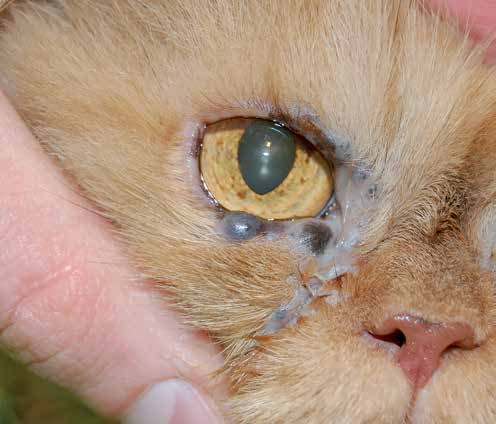
Apocrine cystadenoma (hidrocystoma) in a Persian cat. Multiple black cystic lesions are visible beneath the skin of the eyelids.
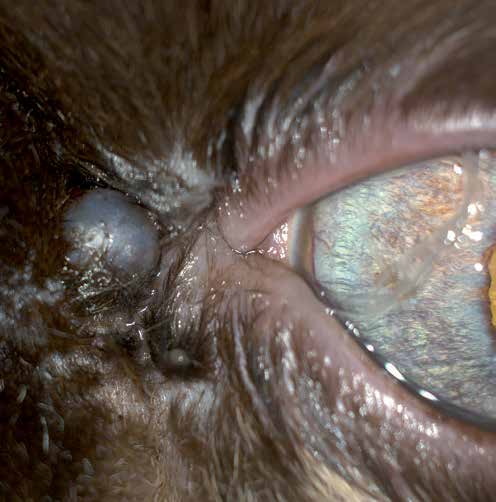
Apocrine cystadenoma (hidrocystoma) in a Persian cat. A round, darkly pigmented lesion is visible near the medial canthus.
Adapted from the Atlas of Ocular Diseases in Dogs and Cats by Dr. Siniša D. Grozdanić and colleagues. © Animal Eye Consultants of Iowa. The text and clinical images on this page are original content from the authors' own clinical practice and research, and may not be reproduced, distributed, or repurposed without permission.
Think your pet may have apocrine cystadenoma (hidrocystoma)?
Early evaluation gives us the most treatment options and the best chance of preserving vision.