
Adenoma/Adenocarcinoma of the Third Eyelid Gland
According to the source, among neoplasms affecting the third eyelid in dogs, adenocarcinoma of the third eyelid gland is most common (85%), followed by adenoma of the third eyelid gland (14%) and squamous cell carcinoma (0.8%). In cats, the distribution differs: adenocarcinoma of the third eyelid gland is described as the most common neoplasm (83%), followed by squamous cell carcinoma (16%).
Adenocarcinoma of the third eyelid gland differs in biologic behavior between dogs and cats. The source states that average survival after diagnosis is substantially shorter in cats because feline adenocarcinoma has greater metastatic potential and a higher risk of recurrence. The neoplasm appears as a firm, smooth, pink mass. Owners initially notice gradual enlargement and hyperemia of the third eyelid. Some animals develop conjunctivitis with abnormal ocular discharge. The tumor may mechanically interfere with normal eyelid function. Benign adenoma cannot be reliably distinguished from malignant adenocarcinoma until histopathologic examination of a biopsy or surgically removed tissue is performed.
Treatment
If histopathology confirms adenocarcinoma, staging should include a complete blood count and serum biochemistry profile, evaluation of regional lymph-node aspirates, and radiography, MRI, and CT as indicated. Complete excision of the third eyelid is recommended in the source for adenocarcinoma. If the tumor has already extended into orbital tissue, enucleation with removal of affected orbital soft tissue is indicated.
Adenomas of the third eyelid gland are benign; the tumor should be removed surgically while preserving a functional third eyelid. Because loss of the third eyelid gland can predispose patients to dry eye disease, tear production should be monitored regularly.
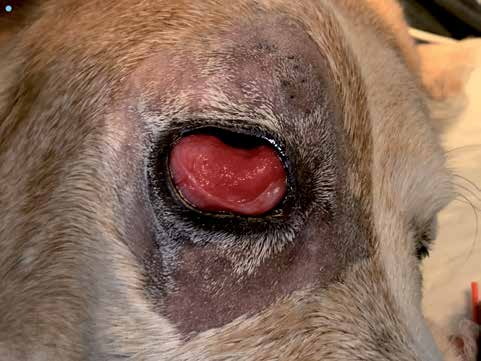
Adenocarcinoma of the third eyelid gland in a dog.
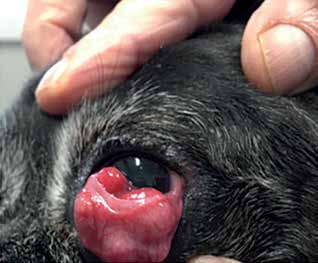
Slowly progressive mass of the third eyelid gland in a dog—adenoma of the third eyelid gland.
Adapted from the Atlas of Ocular Diseases in Dogs and Cats by Dr. Siniša D. Grozdanić and colleagues. © Animal Eye Consultants of Iowa. The text and clinical images on this page are original content from the authors' own clinical practice and research, and may not be reproduced, distributed, or repurposed without permission.
Think your pet may have adenoma/adenocarcinoma of the third eyelid gland?
Early evaluation gives us the most treatment options and the best chance of preserving vision.