
Tear Production Testing
How a simple one-minute test protects your pet's eyes from dry eye disease.
Why tears matter
Tears do much more than keep the eyes wet. With every blink, a thin tear film spreads across the surface of the eye. It lubricates the cornea and conjunctiva, washes away debris, supplies oxygen and nutrients to the cornea, and delivers natural antimicrobial proteins that help defend against infection. A smooth, healthy tear film is also needed for clear vision.
When an eye does not make enough tears, the surface becomes dry, irritated, and inflamed. This condition is called dry eye disease, or keratoconjunctivitis sicca (KCS). It is one of the most common eye diseases we diagnose in dogs, and the Schirmer tear test is the key to finding it.
The three layers of the tear film
The Schirmer tear test measures the aqueous (water) layer, the portion most often deficient in dogs with dry eye. The gland of the third eyelid alone produces roughly 30% of this aqueous tear volume.[2]
What is the Schirmer tear test?
The Schirmer tear test is a quick, painless measurement of how many tears each eye produces. It uses a small, sterile strip of special filter paper with a printed millimeter scale.
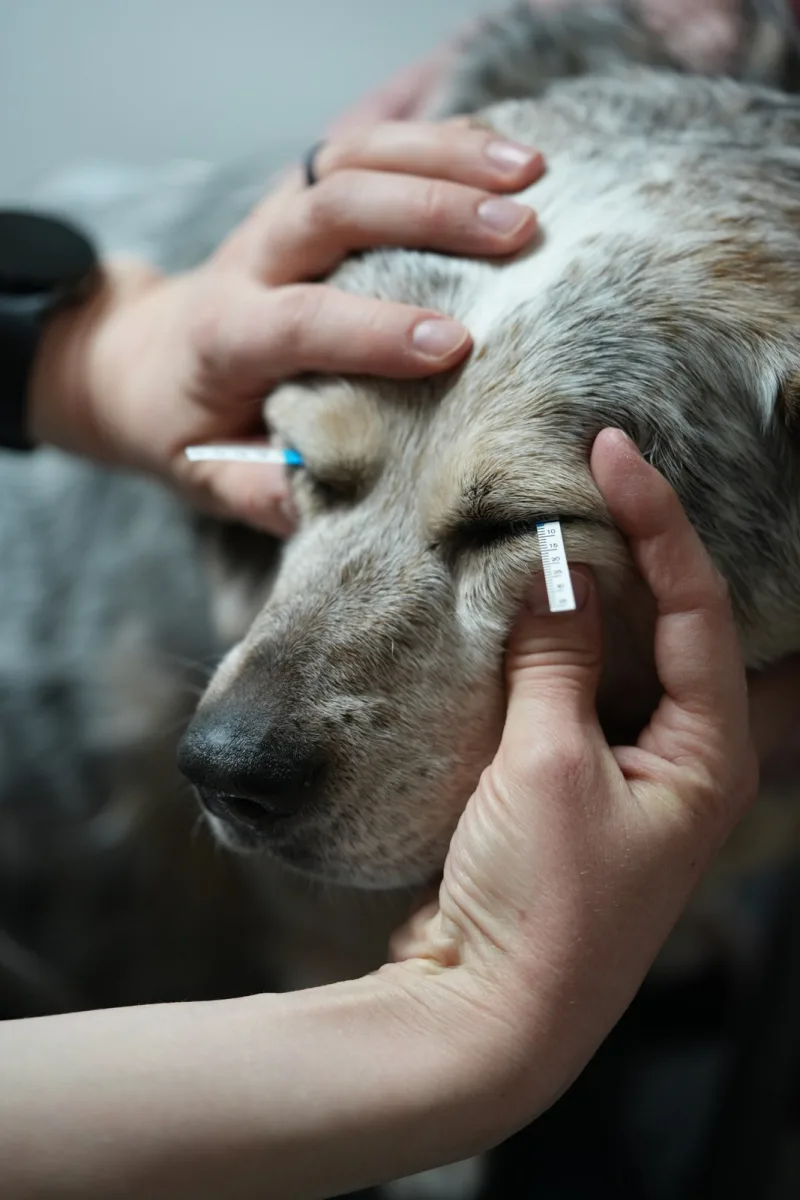
Schirmer tear test strips in place in both eyes.
How the test is performed
- The test is done at the start of the eye examination, before any eye drops, numbing drops, or cleaning of the eyes, which could change the result.
- The rounded tip of the strip is gently placed inside the lower eyelid of each eye.
- The strip stays in place for one minute while we keep your pet calm and comfortable.
- The strip is removed and we read how many millimeters of the strip were moistened by tears. Many strips include a color dye that makes the reading easy to see.
Both eyes are tested, because dry eye often affects the two eyes at different stages.[3]
Understanding the results
Results are recorded as millimeters of wetting per minute (mm/min) for each eye. In dogs, the following general guide is widely used:
Ranges adapted from published veterinary guidance.[2,3] Results are always interpreted together with the appearance of the eye and your pet's history, not as a single number alone.
A note about cats: Normal tear values vary widely in cats, and dry eye is much less common than in dogs. Low readings in cats are interpreted carefully and in combination with clinical signs such as corneal ulcers, a dull corneal surface, or discharge.[4]
Some medications and procedures can temporarily lower tear production, including sedation, general anesthesia, and atropine eye drops. Please tell us about recent procedures and all medications so we can interpret the results accurately.
Why tear testing is so important: dry eye disease
Dry eye develops when the tear glands no longer produce enough of the watery part of the tear film. In most dogs, the cause is an immune-mediated process in which the body's own immune system gradually damages the tear glands. Without enough tears, the eye surface becomes dry and inflamed, setting off a cycle of irritation, loss of the protective mucin layer, and further damage.
Dry eye disease (keratoconjunctivitis sicca) in dogs: causes, mechanism, consequences, diagnosis, and treatment goals. Click to enlarge.
Common causes
- Immune-mediated damage to the tear glands, the most common cause
- Medications, such as certain sulfonamide antibiotics, which can cause temporary or permanent dry eye
- Nerve problems, such as facial nerve dysfunction, sometimes with a dry nostril on the same side
- Congenital underdevelopment of the tear glands in some breeds
- Infectious and systemic diseases, including canine distemper, leishmaniasis, and endocrine diseases such as diabetes and hypothyroidism
- Removal of the third eyelid gland (a past treatment for “cherry eye”), radiation therapy, or trauma
Signs owners may notice
- Thick, sticky, yellow or gray discharge, often worse in the morning
- Red eyes and squinting, blinking, or rubbing at the eyes
- A dull, dry-looking eye surface instead of a bright, shiny one
- Recurrent “infections” that improve with antibiotics but keep returning
- Brown pigment or blood vessels growing across the cornea in long-standing cases
Early dry eye can look a lot like simple conjunctivitis. Measuring tear production is the only reliable way to tell the difference.
What happens if dry eye is not treated
Without treatment, dry eye can lead to chronic pain, corneal scarring and pigmentation that cloud vision, recurrent corneal ulcers, and, in severe cases, corneal perforation and loss of vision or the eye.[1,2] Early detection and treatment can prevent most of these complications.
Which pets should have tear testing?
We perform a Schirmer tear test as part of every complete eye examination. Testing is especially important for:
- Predisposed breeds, including American and English cocker spaniels, English bulldogs, pugs, Lhasa apsos, shih tzus, Cavalier King Charles spaniels, West Highland white terriers, English bull terriers, basset hounds, and Yorkshire terriers[5]
- Middle-aged and older dogs, since the risk increases with age[5]
- Flat-faced (brachycephalic) breeds, whose prominent eyes lose tears more quickly
- Pets with eye discharge, redness, squinting, or recurring eye infections
- Pets taking medications known to reduce tear production
- Pets that previously had the third eyelid gland removed
- Pets already being treated for dry eye, to monitor response to treatment
Treatment and monitoring
Most dogs with dry eye can be managed very successfully with daily eye medications. Treatment is tailored to your pet and usually includes:
- Medications that stimulate tear production, such as cyclosporine or tacrolimus, which also calm the immune-mediated inflammation of the tear glands
- Tear replacements and lubricants to protect and soothe the eye surface
- Antibiotics or anti-inflammatory drops when needed for infection or inflammation
- Treatment of any underlying cause, such as stopping a causative medication or managing systemic disease
Improvement in tear production can take several weeks to a couple of months, and treatment is usually needed for life.[1,2] Repeat Schirmer tear tests let us track progress and adjust the treatment plan. For the small number of patients who do not respond to medication, surgical options may be discussed.
Frequently asked questions
Does the test hurt?
No. The strip may cause brief tickling, and some pets close their eyes during the minute, but the test is not painful and needs no sedation.
Why is the test done before other parts of the exam?
Eye drops, numbing drops, and handling of the eyes can change tear production. Testing first gives the most accurate result.
My pet has watery eyes. Can they still have dry eye?
Yes. Irritation can trigger bursts of reflex tearing, and thick discharge can be mistaken for tears. The Schirmer tear test shows whether overall tear production is truly adequate.
How often should tear production be checked?
For healthy pets, at each eye examination. For pets with dry eye or borderline results, we usually recheck a few weeks after starting or changing treatment, and then at regular intervals.
Can dry eye be cured?
In most dogs it cannot be cured, but it can be well controlled. With consistent daily treatment and regular rechecks, most pets stay comfortable and keep good vision.
Scientific references
1.
Immune-mediated keratoconjunctivitis sicca in dogs: current perspectives on management
Dodi PL. Veterinary Medicine (Auckland). 2015;6:341-347. doi:10.2147/VMRR.S66705.
2.
Canine keratoconjunctivitis sicca
Clode A. Clinician's Brief. December 2015:81-85.
3.
Rule out canine KCS with the Schirmer Tear Test
Merck Animal Health (Intervet). Clinical guide. 2011.
4.
Eye examination in the cat: step-by-step approach and common findings
Stiles J, Kimmitt B. Journal of Feline Medicine and Surgery. 2016;18(9):702-711. doi:10.1177/1098612X16660444.
5.
Keratoconjunctivitis sicca in dogs under primary veterinary care in the UK: an epidemiological study
O'Neill DG, Brodbelt DC, Keddy A, Church DB, Sanchez RF. Journal of Small Animal Practice. 2021;62(8):636-645. doi:10.1111/jsap.13382.
Schedule a tear test or eye examination
If your pet has eye discharge, redness, or squinting, or you are a veterinarian considering referral, contact Animal Eye Consultants of Iowa.